Adventure Under Way . . .
Adventure Under Way . . .
P. O. E.
|
THE cold, sharp air of Massachusetts was charged with anticipation. Behind a curtain of secrecy the troops at Camp Myles Standish were being rushed through a final briefing on their new status as combat-zone soldiers. There were lifeboat drills and gas drills. There were talks on censorship. There were inspections of clothing and equipment. And there were religious services for the men--the last on American soil. Embarkation was imminent. When the regiment was alerted to move on Thanksgiving Day, no old-timer in the 304th was surprised. The regiment had acquired a habit of moving on holidays. It was a good omen, and there were few complaints as thousands of men gulped down early turkey dinners, their thoughts racing ahead to the waiting trains--and to the ship lying a few miles away in Boston Harbor. |
"Luxury Liner"
|
|
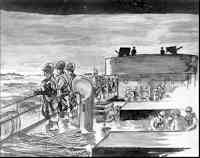
THE Brazil awoke well out to sea. It was morning and troops crowded the decks for their first exciting eyeful of a wartime convoy. Spread out over the dark green water as far as the horizon were ships of many types, each following a prescribed course, with destroyer escorts bobbing about the perimeter, on nervous watch for submarines. Close at hand to explore and enjoy were the intricacies of this erstwhile luxury liner--the naval guns, the complexity of decks, companionways and hatches. Men in khaki were soon correcting one another on the niceties of nautical terms. Yesterday's landlubbers alluded self-confidently to the "stern" and the "bow," "aft" and "for'ard." The ship had no right or left side. It was "port" and "star-board," and to these experienced tars it was "starb-d." |
|
|
|
Life in a Life-Belt
|
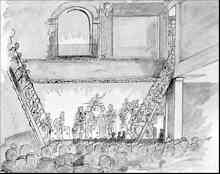
IN the evenings, the ship's dining hall took the spot-light. There, nightly radio shows' played to "live" audiences while those who could not crowd into the room "tuned in" via the ship's public address system. The 304th Dance Band became a star attraction. Professional-level variety shows, staged with the aid of the ship's three dramatically inclined--and
pretty--nurses, fed laughs to the GI passengers. Despite this galaxy of entertainment, probably the most popular activities were letter-writing and the simple pleasures of lounging on deck, watching the progress of the convoy. There were serious moments, too. Every day religious services for all faiths helped the men to prepare spiritually for what lay
ahead. |
 SEAWEED ROOM |
|
Boat-drill was everyday
routine. Every man knew his life-raft station and the exact route from quarters to
station. Blackout restrictions were rigid from sundown until sunrise. Life jackets became part of the uniform night and day, to be worn wherever the soldier went on the
ship. |
|
British McCoy
|
|
IN the soft glow of an afternoon sun the
Brazil hove into single file with other ships of the convoy, her rails crowded with men drinking in every detail of the unfolding scene. Another convoy passing to port . . .
. a British heavy cruiser at anchor with her crew in formation on deck . . . a Sutherland dipping low over the ship a flak tower rising out of the Channel waters. The convoy steered around the Isle of Wight, which guards Southampton's great channel and divides it into twin tributaries, the Spithead and the Solent. Passing the ancient marine city of Portsmouth, the vessels swung into the Spithead and steamed slowly up the twenty-seven mile run to the docks of Southampton. |
|
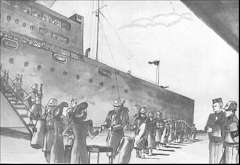
Throughout the night the troops waited their turn to disembark. As the last elements trickled down the gangplank at
Southampton, the first elements had already been installed in quarters--the marshaling area at
Boscombe, a suburb of Bournemouth, County of Hants. Here they were to learn a new way of Army life. Instead of the tent city their imaginations had
conjured, they were housed in "billets," an English term for civilian residences commandeered as troop
quarters. |
|
Boscombe Christmas
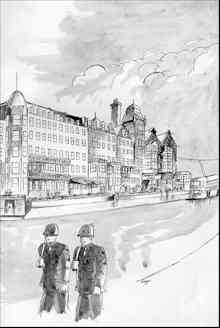
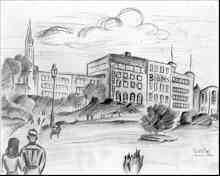 BOURNEMOUTH SKY-LINE |
WHILE
the regiment waited in this semi-luxurious marshaling area, there was
ample opportunity to learn about England and the English. GIs were
surprised with the discovery that English girls knew--and liked--the
American way of dancing. There was the tea-time habit and the
pounds-to-halfpenny headache. There were the pastry shops and the
"3 and 6" stores; there were pubs and the English "cinemas." |
|
|
|
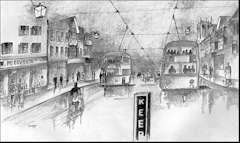 CHRISTCHURCH ROAD |
What was probably known to very few of the many people watching this unusual sight was that each man who marched at attention down that street and through the doors of Corpus Christi Church was there of his own free will, in a completely voluntary attendance, a perfect example of a working democracy even in wartime. In fact, a majority of the men in that parade had already been in attendance at earlier Masses on that day. Inside the church Lts. William McDaniels and Richard Keefe served Mass, a military choir of officers and EM sang during the Solemn High Mass and the Color Guard flanked the altar at attention throughout the entire service. Lt. Robert Priaulx was the Master of Ceremonies. The sermon, preached by the pastor of the church (an English Jesuit), expressed to all of these men a full sense of the high edification to which they had given rise. |
|
Visits to London were high on the priority list. Special trains carried hundreds of 304th men daily to the wartime capital to discover for themselves Buckingham Palace, Westminster Abbey, Piccadilly Circus, Hyde Park, Selfridge's, Madame Tussaud's Wax Museum and all the sights of London which could be crowded into a two-day visit. There the men saw their first blitzed city. There they experienced the Nazi's eleventh-hour torture of English civilians, the buzz-bomb. |
|
next
page:
Adventure
Under Way . . . (continued)
previous page
-- contents