90: Tangent . . .
90: Tangent . . .
|
The work of the historian-especially of one who has been a participant in the fact--is fraught with peculiar experiences. It is packed with nostalgia. It is vivid with memory, and with suspense almost as keen and clear as the event itself. At points such as this, for example, the chronicler finds blood racing through his veins, his breath quickening and. almost panting as if from running. The remembering of these things is still as real as was the actuality itself. |
Divisional Reserve?---!
|
THIS may render it easier to understand what the true pace of the race must have
been. The pause which took place after Meckel, Helenenberg, Olk and the arrested march on
Trier, was long enough
only for a swift readjustment of routes and positions. It could not actually be called a breather--far, far less than
that. Capt. Ryan in his diary sounds the keynote: "That evening we moved back towards
Meckel with the story that we were going back for a rest . . .
The Gadget (T/5 Mignon) picked me out during the show
(three hours later!) to report back to the CP and there I was told that the rest had about ended . . ."
Up again and off
again. On March 2nd at 2000 the notation is in the regimental journal: "Closed
Regtl. CP at Gilzem" and two hours later: "Opened CP at
Welschbillig." |
River---
|
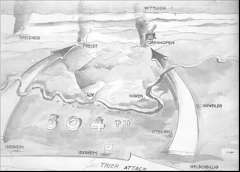
THE front from which the regiment was to jump off in this new phase stretched along the tortuous course of the
Kyll River from
Kordel to the southeast of Welschbillig and northwards all the way to a spot opposite
Hosten which still lay in enemy hands.
The program--to put it very simply, leaving aside all the detail of the Divisional order was to cross one river and, to drive straight through to the banks of another after that--this time the
Rhine. It all sounds simple when put down that way.
The only difference of any importance was that both east and west banks of the river consisted of densely wooded, precipitous slopes.
These natural obstacles once overcome, there was beyond them the enemy defenses spread through
Hosten and Auw and
Speicher and Preist and
Orenhofen. The story of these names has since then been written in blood.
Specifically, a Task Force known as "TF Onaway" had been formed by Division, composed of tanks,
TDs, armored cars and motorized infantry.
Beyond the Kyll
there lay some relatively flat country and it was the mission of this force to reach it and drive on through to
Koblenz and the Rhine.
After that--time would tell. Again it all sounded very simple--this matter of reaching the
Rhine; but, as always, a bridgehead had to be established here in order to cross this other river some 100 kilometers away.
This was first. Without it the other was impossible. |
-- And Cliffs
|
"IN our attack across the Kyll (still with the 3rd battalion) the Engineers had trouble working on the bridge. They and Lt. Katz (I Company) were pinned down for quite a while at the site of the bridge before they could go to work on it. The river wasn't much but the sides were sheer, slippery precipices and were almost impossible to walk over--much less to fight over. Here Col. Barber again saved a lot of lives, I think, by holding up the hour of his attack until the bridge was in and shelling abated. The troops crossed and fought their way up through snipers, machine-guns and mortar fire on their way to Orenhofen." The Blue battalion history uses a few more words than usual in describing this progress to Orenhofen." . . . and the troops moved to an assembly area for the crossing. Heavy mortar fire and rocket fire kept the troops down at the assembly area until 0105 when the battalion moved out to cross a foot-bridge. By 1000, 4 March the battalion had crossed the river and had taken Orenhofen . During the afternoon the battalion repulsed two counter-attacks of infantry and tanks firing direct fire at 1000 yards and held the town during the night against infiltrating patrols. During 5 and 6 March repeated artillery and rocket attacks were made on the town. 283 PWs were taken in Orenhofen." |
P. W. "Gives"
NIGHT CONVOY |
WHAT the battalion history does not mention is the capture of one PW in particular by the battalion before the crossing was even begun--this would be at about 2200--and the difference which his capture made. It is safe to say that without the information elicited from him by the skillful questioning of Sgts. Mann and Madauss of the IPW team, casualties might have been far heavier, the success of the crossing itself, far more in question. When they had finished putting him through the wringer there was no sap left in him; everything had spewed out. Positions of mine fields and road mining's--bridge conditions and plans for the blowing of them (using our own duds)--the preparation of wide and deep craters along what was supposed, to be the probable route of our advance--road blocks--tank obstacles, artillery positions, troops and their dispositions and numbers; everything finally seemed to spill out of this "super-man." When he had finished talking, it was a rush job. The information had to be reassembled and collated at lightning speed, submitted to regiment, sent to battalions and to Division. |
|
But when the job was done it must have been a terrific satisfaction to these men--the realization that certain overlays (and
plans on the overlays) would be changed in
time so that some of the men up ahead. wouldn't be "cashing in their chips' this time.
Again, it was part of that, all-important coordination of a combat team. |
|
next
page: 90: Tangent . . .
(continued)
previous page
-- contents