|
AN industrial city with a peacetime population of 40,000,
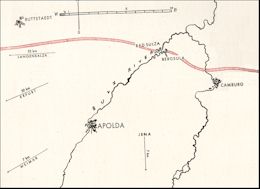
Zeitz was no pushover. A bend in the
Weisse Elster River embraced the city on three sides, forming a defense which dated from medieval days, when it was used as a moat before fortified walls.
High ground around the old church dominated the river and the green fields beyond.
Tentative probing by the armor had given ample warning that the city would be defended with every trick in the Nazi bag--from 88 mm AA guns to civilian snipers.
A hodgepodge of Wehrmacht troops held Zeitz, most of them from Volkssturm units and replacement battalions.
Panzerfaust men of the 2nd Air Force had been rushed in the day before. Deployed in and around the city were seven companies of NCO school enrollees.
Infantry would have to bear the brunt of this attack, that much was certain.
Col. Choquette gave the assignment to the 1st battalion, with Companies G and H of the 2nd battalion, supporting.
For heavy support there were 6th Armored tanks and Cannon Company's howitzers.
According to Col. Lawlor's plan, Baker and Charlie Companies, on the left flank, were to approach over two bridges from the north, while Able Company attacked over the large concrete-and-steel structure on the right. Dog and How, heavy weapons outfits, were to split up in support of the attacking riflemen.
(It is interesting to note here that Dog Company records that in the first half hour of the battle they fired over 700 rounds.
Behind this lies a story of fast and bitter action--but it merely reflects the entire tone of that entire day.)
Sometimes battles go according to plan. This one didn't!
At the same moment that Sgt. Christy, of the 301st Engineers, had arrived to determine whether the bridges were safe, two of them blew up in tremendous explosions.
The third was already kaput. Now, improvised methods of crossings must be devised.
Baker Company had the least difficulty. Approaching the blown-out bridge, the company commander decided that the troops could cross over on the rubble.
But snipers from the far shore were pinning down the company. So " Mac's" heavy machine guns were called up to the river bank to form a base of fire with the riflemen.
A rain of lead covered the scouts as they crept over the wrecked bridge and cleared houses nearby.
The company followed; and positions on high ground overlooking the town were manned by H Company machine-gunners.
C Company, meanwhile, was having trouble. As he moved up with his company in an approach march along the railroad tracks paralleling the river, Capt. McGrath knew that the bridge had been knocked out.
While he reconnoitered for an alternate means of crossing, patrols to the flanks searched out buildings located near the railroad terminal.
A burp gun spluttered from the police station. A quick grenade through a window stopped the burp and flushed out forty Nazis.
Immediately, as if released by a spring, a new nest of enemy snipers and machine-gunners opened up from the opposite bank; and, still with utter calm, the search for an approach to the crossing went on.
(Meanwhile the tanks through their radios had picked up more than combat messages.
As the columns advanced the news was passed along by word of mouth: "President Roosevelt is dead!"
The attack increased in bitterness.)
When the crossing had been selected, 1st platoon of Charlie Company moved up to cross the trestled overpass leading to the fallen bridge.
Just as the men approached Sgt. Christy, the 301st Engineer came rushing up with word that the structure was charged with three 1,000-pound bombs.
The fuse wires were cut, and the men struck out, chastened, however, by the thought of what
might have happened. Enemy fire was becoming heavier and movement was limited to short, crouched rushes, up to the river.
The men scrambled forward into the water, half-wading, half-swimming near the ruins of the bridge.
Almost to a man, they were swept off their feet by the swift current amid the debris.
But hesitation was "N.G." at a time like this. It wasn't comfortable at all, being a fish in a barrel for enemy machine-guns.
Once on the other side, dripping wet and out of breath, they rushed heavy machine-gun positions and scattered enemy snipers.
The 3rd platoon held, the others by-passed into the town. Eight tanks, by this time, had moved up to the trestle across the river and opened up on the buildings near the riflemen's positions.
Blasts of 75 mm shells blended with explosions of enemy panzerfausts; fire fights spread and flushing groups plunged into the work of clearing the first houses.
On the right flank, Able Company, too, had made the crossing.
Capt. Parker had used his broken bridge to good
advantage.
|