|
In the march from McCoy to the
Zwickauer Mulde the 304th soldier has worshipped on the decks of
ships, on snow-covered fields, in haymows, schoolhouses, farm-yards and
cowbarns, in beer halls and night clubs, in railroad stations and aid
stations, in theatres and in factories. All these, together with some of the oldest and most beautiful cathedrals in
Europe, have been the
churches, the sanctuaries for the regiment in combat. The bare listing of
them, such as above, is no adequate catalog of the "field
expedients" into which the Chaplains were forced, not once but time and over
again. It is, however, the best possible illustration of what was, in
battle, the very real urgency of worship for the fighting man!
The true record of that urgency exists only in the memories of the Chaplains who served this regiment and who will never forget the sights which they
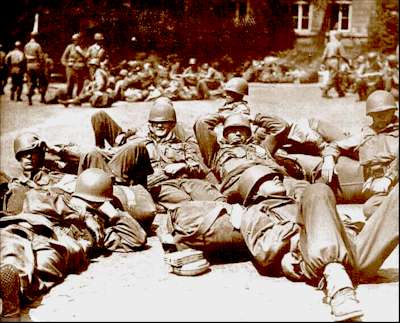
beheld, again and again, of men unshaven and unshorn for days at a time,
dirty, bloody and battle-stained, stopping for long enough, wherever and whenever they
could, to free their hearts from the ugly blot of war by a moment of communion with their Creator.
The religious life of the regiment is not something which can be reduced on paper to catch phrase or cold
fact. It is embodied in the traditional faith which a man carries with him in the change from a civilian to a military
existence. In battle it is also--and far, far more so--the one great source of inspiration and moral
fortitude; it is the foundation stone of that intangible which is known in the vernacular as
"guts"; it is the recognition of individual human worth in an atmosphere which totally genies that
worth. The interpreters (or, rather the elicitors) of this life have been the regimental
Chaplains. Though they represented different faiths, Chaplain Kolenda as a Catholic priest and Chaplains Lynn and Wenger as Protestant ministers have worked together harmoniously towards a common
goal. The stories of their missions are therefore treated here as one.
As the regiment came closer and closer to the front lines it was inevitable that there should be a growing awareness of the overweening need for spiritual guidance in moments such as those which lay
ahead. As evidence of this axiom, during the last weeks and the last days at
Camp McCoy, during the processing at the
P.O.E., and far more noticeably (perhaps because of the constricted
quarters) on the troopship, more and more men attended all the services of all
denominations. The Chaplains, during this period, literally could be said to have had
no idle moments--apart from those few hours which they were able to devote to
sleep. Men were coming to them in what seemed to be droves for the solution of all types of
problems, both material and spiritual. It could also truly be called remarkable how often these material problems seemed to serve only as a
mask, as a pretext for the deeper, underlying troubles of the mind and of the
soul.
When finally the regiment went into
battle, the Chaplains were with their men ready to aid them as friends, to comfort them as
pastors. The white-crossed jeeps could be seen daily, up where the 88s and the screaming meemies were
falling. They roved from one forward position to another. They parked outside of the collecting stations and the battalion aid
stations. |

Chaplain Herman Kolenda and T/5 Fred Krause |
Here it was their experience, day in and day out, to meet the wounded and the dying as they came to the operation litters for
surgery. So frequently that it was for all practical purposes a daily
occurrence, they divided their efforts between being medical aid-men and ministers of
God, administering plasma in almost equal quantities with spiritual
comfort. More than once the Chaplains and their assistants served as litter-bearers when the aid stations were
short-handed. Father Kolenda, who cared for all Catholics in the
regiment, saw more than five hundred men within the space of three days during the time when casualties were the
heaviest.
|
|
Often, he was glimpsed by many, giving Holy Communion to a group of soldiers kneeling by a muddy
roadside. Chaplains Lynn and Wenger made religious contacts with many small groups up front, when regular worship services were
unfeasible.
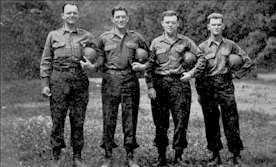
And the Chaplains to the last man were unanimous in acclaiming the nerve and the loyalty of their assistants, T/4 Frank Knapp, T/5 Leroy Taylor and T/5 Fred Krause, who accompanied them without exception on every one of these missions no matter how dangerous they might have been.
With the end of the war in Germany the Chaplains could again schedule regular Masses and services.
Displaced persons by the thousand were being encountered. And, being ministers of God, their duty was to all nations and to
all peoples. To Father Kolenda, in particular, there now came a peculiarly happy opportunity to minister to large numbers of Catholic French, Belgian, Hungarian
and Polish people whose language he himself talked. AMG itself more frequently than not had recourse to the Chaplains in sifting many of these D. P. problems to the bottom.
As the war ended all the Chaplains and all the men were able to agree with the words written by Chaplain Wenger
"Our soldiers have made the same discovery which others have made in the past.
God is found not only in the cathedrals and temples, but is present wherever men seek Him.
They have found that of which the Psalmist David spoke when he said 'Whither shall I go from thy Spirit?
If I take the wings of the morning and dwell in the uttermost parts of the sea, even there shall Thy hand lead me and Thy right hand shall hold
me."'
|