Rapier to the East . . . (continued)


Devil Take the Hindmost

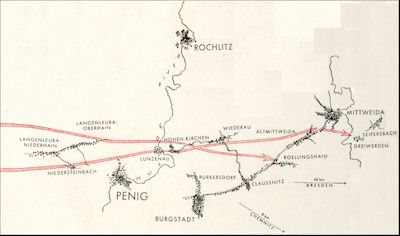
ALONE, CT 304's 2nd battalion was holding the outpost of the deepest American spearhead into Nazi Germany. The road for the day had covered, roughly, seventy-one kilometers.
The Allied advance by now was in a state of glorious confusion. Americans competed against Americans in the race to reach Berlin, to reach the Russians, to end the war. In such an exhilarating atmosphere, the 3rd battalion had moved out on April 13th--to join Combat Command B of 6th Armored Division. Because the Zeitz bridges were blown and the Engineers had been unable to throw up a Bailey bridge in their place, the battalion had been ordered to cross near Pegau. But this was in First Army territory and First Army denied the battalion access to the bridge. Priority was for First Army units alone.
Thus, the battalion lost contact with CCB. Immediately, a new mission popped up--to take Altenburg with Combat Command R. Sunrise April 15th saw tanks, TDs and 3rd battalion infantrymen in position on high ground overlooking the thousand-year-old city. Tank guns poured shells into the center of the city as riflemen awaited the attack order. One company of the battalion was to advance along the main road, another to the south, while elements of the 603rd TDs pushed in along the railroad embankment, completing an enveloping movement.

Surrender - New Style


DAY'S CATCH

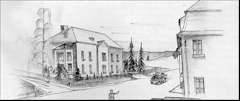
BUT the attack never came off. As the armor and troops still waited, Capt. Ryan was lifting the telephone receiver in the quiet of the 3rd battalion aid station at Rositz. Over the wire came a German voice . . . "The shelling, it must stop . . . the German troops have given up . . . the city surrenders . . ." It was the b|rgermeister of Altenburg. Thus, one of the oddest surrenders of the war was made to the 3rd battalion Medical Section.
This version of the fall of Altenburg, however, is not completely accurate. It was written by a battalion historian and has certain elements of the truth in it.

The precise account of what happened is contained in the story written by one of the aid-men who was present at the incident whilst it took place. His account is as follows: "At about 0830 we arrived in the town of Rositz which was about 4 kilometers away from our objective (Altenburg). With tanks, TDs, infantry and air power within call and a good sized town (80,000) to take, a real brannigan seemed to be shaping up. Meetings were held at the various CPs--coordination effected--plan of action made--K Company here--L company there--everything to begin at 1100. Our medical section 'liberated' a fine house belonging to a female physician prominent in Rositz, and prepared for casualties . . . Suddenly the phone rang. Commenting on the possibility of people in Rositz calling people in Altenburg and letting them know when we were coming and with what, we dispatched a runner to the CP to get the town's phone system disconnected. Having turned the matter over to the proper authorities we sat around complacently wondering about the prospects of a hot bath. The minutes ticked off . . . it was 1030 . . . then 1040 . . . then 1050--everyone automatically was up and moving restlessly around when the unexpected happened--the phone we had thought silenced rang again--a call for the German doktor--a series of unintelligible Boche sentences spoken in a hurry and then the woman turned breathlessly to us and spoke: 'That was the b|rgermeister of Altenburg-he called to say the town was surrendering--no defense will be offered--white flags will be up--no shooting is necessary!' Lt. Helmer Miller was sent flying to the CP by Capt. James Ryan after Capt. Kowalec of Collecting Co. A acted as interpreter with the German physician. Dashing wildly through the streets by jeep Lt. Miller burst into the CP a moment before 1100 and broke the news of the surrender of Altenburg--and stepped back--expecting thunderous applause, or at least an awed silence. Maj. Lyle Griffis looked up drowsily, yawned and said: 'Yeah, we know. Our patrols entered the town a few moments ago.' An anti-climax, if ever there was one!"
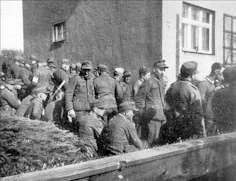
With its mission accomplished (for once without a fight) the 3rd battalion moved into Altenburg to corral two thousand prisoners and a vast amount of enemy materiel including one of the largest ammunition factories in Germany. Leaving Company L to guard installations and prisoners, the battalion joined the regiment in a move to Wiederau, a few kilometers behind 2nd battalion positions.
Meanwhile, 1st battalion, after being relieved by the 417th Infantry at Zeitz, had been assigned to a special mission in support of Task Force Lagrew of the 6th Armored Division--the seizure of vital bridgeheads over the Zwickauer Mulde River. By the evening of April 15th, the battalion had completed its work and reverted to regimental control. Now the three battalions, pursuing different routes and accomplishing different tasks, assembled in a new regimental sector along the Zschopau River. At this outpost of the Allied front the regiment halted--only because so ordered--to await contact with the Russians.
The rank and file had their eyes peeled for two expected events. First, there was the strong probability of a counter-attack by the enemy designed to pinch off the combat team's advanced position. Second, and more exciting, was the prospect of meeting the Russians.

On April 15th, which was a Sunday, the regimental CP had stopped in Altenburg for a matter of a few hours. East of Altenburg, of course was Mittweida which, in general, was the regimental objective. Approximately ten kilometers slightly southwest of Mittweida was the town of Wiederau--and this was destined to be the next stop for the regimental CP. About all this there hangs a tale--the story of how Mittweida came to be known throughout the regiment as "the town that the Chaplains took!"
With the advance moving as it did it was inevitable that the various elements of columns on the move would occasionally stray and sometimes hit a destination entirely apart from that originally intended. And that was more or less what happened in this case. The CP left Altenburg headed for Wiederau, but when it left it did so without Chaplain Lynn or his assistant and driver, T/4 Frank Knapp. There was still some business which had to be completed--they knew the intended destination--they had a map--they would follow later!
When they did start, it was later, much later certainly than they had either intended or expected. With Knapp driving and Chaplain Lynn in the jeep and the trailer rattling along behind, they tried to make up for lost time. Unfortunately, somewhere along the line a wrong turn must have been made and night began to fall--and the damage was done right then and there. Wiederau was the destination--but where was Wiederau? They seemed to be able to locate every other town in the sector but that. Finally in desperation it was decided that the next town they hit and which looked as if it might have habitable dwellings in it would be the night's stop. No sooner said than done--and it turned out to be a spot called Mittweida.
Unfortunately, Chaplain Lynn's command of German failed him completely at this point--probably because of the fact that their host turned out to be a Russian slave laborer and his family--and his command of German was even less than the Chaplain's. This man, however, gave them a profuse welcome and it would have been unthinkable to have--moved elsewhere--his feelings would have been irremediably bruised and international relations might have suffered as a consequence. For him these were American soldiers. This was the day of victory and deliverance. So that was it--lodging and food for the night. And a very pleasant and comfortable night they did spend there. (The truth of the matter is that even if they had known the real condition of affairs, they would still have been so tired and disgruntled that they would have slept none the less soundly!)
Very early next morning Frank Knapp woke and looked out the window to see American troops moving through some outlying fields towards the town in skirmish formation. It was a peculiar sensation to realize that one was on the receiving end from one's own troops. But, Mittweida, praise the Lord, was lightly held and to their intense edification (and relief) they saw it surrender soon afterwards from within. The climax of the story came when they discovered that in reaching where they had finally arrived the previous night they had not actually missed the town of Wiederau--what they missed was the regimental column--for they had passed through Wiederau before the regimental CP had even arrived.

"Russkis Are Coming"


CLAUSSNITZ CP

WITH the regimental CP moved up to Claussnitz, the troops dug in along a defense line approximating the course of the Zschopau. The sector at first held alone by 2nd battalion was now shared with the 1st battalion, while 3rd battalion guarded warehouses, supply dumps and ammunition trains at Burgstddt, the division CP. For several days a state of readiness was maintained to repulse the expected counter-attack.

A captured German soldier volunteered the information that SS troops were planning to counter-attack trough 1st battalion positions on the night of
April 16th. Beating them to the punch, Col. Lawlor dispatched Charlie and Able Companies in an attack across the river that night. The two companies, wading the Zschopau in neck-deep water, pushed the enemy out of the towns of Dreiwerden and Seifersbach on the opposite bank. It was an ugly job, Charlie Company having one man killed and another wounded; but the counter-attack died still-born.
The troops still had their eyes peeled for the Russians. And by all rules of logic, CT 304 should have been the first unit to contact them. Along the front GIs spotted the prearranged red flares of the Red army and sent up welcoming green flares. Infantrymen volunteered to patrol the area in hopes of being the first to meet their Red partners. At 1st battalion CP in Altmittweida there were more photographers' and correspondents' jeeps than combat vehicles, and a large party moved out to the forward positions of C Company to wait for the big moment. It didn't come. When the actual junction came at Torgau it was by a patrol of the 69th Division which had later drawn up on the north flank of CT 304. There was disappointment and some GI gripes.
The most disappointed and disgruntled man in the entire regiment probably was Lt. Marion D. Cloud, platoon leader of the I & R. Word had come that the Russians were approaching Mittweida--if they were not already there. This news must have filtered through during the night because bright and early on that particular morning the entire platoon was routed out and rushed through an early breakfast in the half-broken dawn, piled into their jeeps and rushed off to an unknown destination. (The lieutenant had let fall an inkling of the mission and as a result there was another weapon besides the usual ones carried on this trip--every kind of a camera that could be mustered on that short notice.) Out from Penig they went, winding their way swiftly to Burgstddt (where their last OP of the war was situated) and picked up two of the lads stationed there, Hrusch and Sucharyk, to act as interpreters with the Russians - as, if and when!
Leaving Burgstddt they ran into what looked for a moment like a spot of trouble. This merely developed into a horde of German soldiers trickling, in an ever increasing stream, down the road--completely devoid of all armament--and hoping only for the permission to surrender to the Americans rather than to the Russians. These streams of refugees and defeated Wehrmacht were thick along all the roads the platoon traveled that day. Back through Claussnitz (the scene of a former CP and OP) they sped and straight out along the path to Mittweida.
This was already a maelstrom of confusion. The citizenry alternated between milling about aimlessly or standing in almost inanimate knots or groups or leaning impassively out of the windows overlooking the square, watching the scene for which the city was the setting today. Some Russian equipment was parked in the square and Russian soldiers were sauntering about in a casual, disinterested inspection. But through the square was flowing a ceaseless stream of other vehicles and men. They traveled on anything and everything that would move, carry or pull them--right down to horses and carts.
Without any further ado the Lieutenant and the platoon moved off for a closer inspection of this strangely glamorous picture--this was what they had been waiting for so long to see--the Russkis finally were here. Specifically, they were in search of the Russian Commandant or of any Russian officer who could lead the Lieutenant to him in order to report and to extend the Colonel's cordial regards and to invite him to a meeting with the Colonel. No sooner said than done. An officer was found and the process of interpreting began. The first step of the conversation was a shaking of hands all around. The next social amenity was an exchange of apples for cigarettes--followed by a long-winded mutual admiration contest. A little further along a few more cigarettes changed hands. The Russian officer himself now pulled out a packet of Russian cigarettes and Lt. Cloud lit up one of these.
This looked like a good moment. "Stormy Weather" cleared his throat and explained to Hrusch that he wanted to find out precisely who this officer was and where he could find his Commandant. Hrusch nodded his head understandingly and turned to the officer--and just then a Russian private rushed up and rattled off some words so fast that even Sucharyck and
Hrusch could not understand what was said. The effect was electric-- the officer snapping to attention, saluting, shaking his American "comrade's" hand, rattling off what must have been a profuse apology, turning on his heel--and the next moment he was gone.


SURRENDER

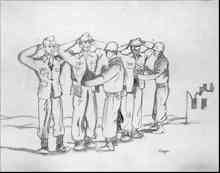
And that was that. Inside of five minutes the square was cleared of all stationary Russians--they too had joined the column and were off. Lt. Cloud lifted the cigarette he was smoking to his lips, only to arrest it in mid-air and look at it thoughtfully. The next moment he had carefully stubbed it out and dropped it delicately into an envelope in his pocket. A Russian cigarette stub--actually his only evidence that he had met the Russians!


next page: Rapier to the East . . . (continued)

previous page
-- contents