Rapier to the East . . . (continued)


Retreat Before an Ally

IT suddenly developed that the 304th was holding positions in advance of the line of demarcation prearranged between Russian and American commands. To adjust the lines, the regiment withdrew April 25th to the vicinity of Penig and Burgstddt where new defensive positions were occupied. For the 304th Combat Team the move to Penig marked, in effect, the end of the war with Germany--two full weeks before the official surrender announcement by Washington and London.


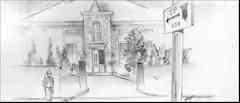
PENIG CP

Probably the last round to be fired by the combat team came from the muzzle of a 302nd Field Artillery piece. From his OP in a high tower in Burgstddt on May 7th, Lt. J. H. Singleton, Jr., artillery forward observer attached to E Company, was firing the customary registration. The first round went out and he sent back the sensing--four hundred over. Then came the "Cease Fire" order. The Russians were "on their way in." In a hilarious exodus parties from the regiment went out to meet their co-conquerors. Russian and American smiled at one another--and exchanged apples for cigarettes. And that same day Lt. Singleton inscribed the following in his diary:
"Conclusion. This is only an account of the company (Co. E) and the FO section as a whole. Many volumes could be written on the untold heroic acts of every man in the company--such as Lt. Fenimore getting a shell fragment in his foot on the very first day of the attack and continuing to stay in the fight until the next day when he was evacuated against his own will because infection had set in. Or Capt. Maberry, without regard for his own safety, always in front and leading the company through dangerous situations when it looked like almost certain death for him. His keen judgment was a quality about him which I shall always admire. He would walk ten miles out of the way over the most difficult terrain if it would reduce the chance of one man's being injured. Much could be said about the non-coms of the company also. When their leaders fell in combat they were always quick to move up and take their places, never failing to accomplish their mission. And last but not least I must say quite simply, because that shows the most of all my sincerity, all praise to my own men in the FO section!"

Last OP.

FOR a long while the I & R platoon had had a tour of duty completely devoid of "static" OPs. Observation, of course, was still part and parcel of their work but posts such as they had had back in Luxembourg and for a short period thereafter had stopped almost completely just on the other side of the Moselle. Route reconnaissance, contact missions, jeep riding, jeep riding and more jeep riding had become the order of the day. Now, as the regiment moved way up into this new "finger" the old style of OP came into sudden fashion again. From Claussnitz on, the Russians and Germans both were being expected. Everyone, was on the watch for them--the I & R being no exception.
By a strange coincidence the last two OPs set up by the platoon were exactly similar in that railroad shacks housed them both. The first, outside of Rvllingshain, combined two dug-outs with the shack and communication between the dug-outs of the line companies all along the front. The next--and the last--OP in Burkersdorf, just to the north of Burgstddt occupied a forward, central position in the regimental sector line of defense. And again it was a railroad shack, this one being complete with switch-tower and the switchman's house which automatically became the billet for the crew who ran the OP. By the time this post was in complete operation it resembled a telephone switchboard more than anything else. It had lines strung to the north and the south and branches to the east and the west and was so complete in its coverage that there was not a single spot on the entire front from Hohenkirchen, where F Company was holding down, to Burgstddt, where E Company was outposted, which did not ring through the regimental OP. The "news service" was complete. The credit for it goes to T/5 Wally Turner who was in charge of the OP and who was also one of the regular commo men for the platoon, and to Pfc. Frederickson whose successful puttering around with all the lines, with the EE-8s and with the sound-powers, finally filled the signal tower so full of phone bells and whistles from incoming calls that it was, at times, somewhat of a mad-house.
After chasing and battling the Wehrmacht four hundred miles across Germany in a matter of fifty days, the regiment was now in the strange position of sitting down to await the war's end--while the war moved ahead elsewhere. For the first time, the troops could be reasonably sure that they would be sleeping in the same bed tonight as last night, and the night before. For the first time they were having real untrammeled hours to spare for hot showers, movies, relaxation--and for a calm, backward look over the past months.
What had been a kaleidoscopic collection of memories now focused into a complete picture of combat experience, with scenes of Orenhofen and Gilzem, Preist and Wehlen, Zeitz and Dreiwerden painted in unforgettable strokes against the background of a sweeping Odyssey through Germany. There were the lines of straggling prisoners they had taken (nearly 7,000 during the campaign), and the scores of villages whose names were forgotten almost as soon as they were taken. There were the thousands of comrades-in-arms and enslaved peoples whom they had liberated.
There, too, were their fallen comrades who never again would stand in a company formation--twenty-one from Company I, eighteen from Company K, and so on down the line.


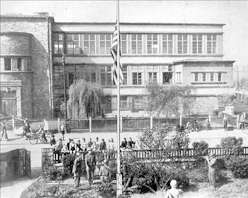
PENIG CEREMONY

May 8th

AND now for the first time also, the attention of the men was directed from their own fight to the broad panorama of the war. In hours of leisure almost uncomfortably novel, they watched the last of the rulers and the armies of Nazism whisk into oblivion like dolls in a puppet show . . . Berlin, what's left of it, falls to the Russians . . . a million German troops in . . . Italy . . . southern Europe surrender unconditionally . . . Goebbels dead . . . million German troops in northern Germany . . . Denmark . . . . Holland . . . surrender to Montgomery . . . another half million to Devers in Austria . . . Von Rundstedt a PW . . . Hamburg falls . . . Goering captured . . . Nazis . . . Norway . . . surrender . . . en masse . . . Himmler . . . suicide . . . ADOLF HITLER DEAD . . . Admiral Doenitz proclaims unconditional surrender of all German fighting forces. Then . . . V-E Day . . . announcements . . . Washington . . . London . . . Moscow.

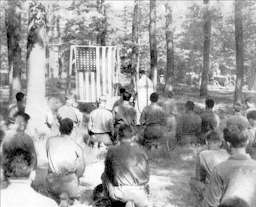
The Victory Belongs . . .

These were the symbols of victory for the world, for the masses now freed from Nazi bondage, for the masses who had struggled through a grim sixty months of the most brutalized warfare mankind had ever seen. For the average GI of the regiment, victory was this, but also something more personal-- something tied up inextricably with a hundred small incidents and monotonous jobs. Victory for him was the sum total of all of the hours of standing guard in danger-ridden places; of driving blackout through sleepless nights; of poring over maps and reconnoitering enemy territory; of ministering to the wounded; of keeping ears strained for a vital radio message; of getting chow up to the line; of searching enemy ground from a lonely OP; of brainwork and planning--and of plain, unadorned fighting. To the men who had done these things--to the service echelon, medics, MPs, to cooks and clerks, as well as to fighting men - this was victory. To them victory belonged, as it did to men of the Artillery, the Engineers, the Tank Destroyers and AAA who had been members of the combat team. And in a special sense, for the men, victory belonged to the scores of their comrades who had given their lives to achieve it, and to hundreds more who had been carried from battle . . . W.I.A.


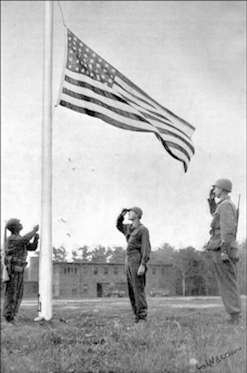
VICTORY SALUTE

Unmentioned

THIS is the sort of a moment which for the historian also has special significance and at which, perforce, he must pause. It means that he is near to the end of his labor; but it also means that he must take stock not of the good work which he may have performed but of his errors--whether they may be of omission or inaccuracy or ignorance. He leans back in his chair and allows the events to pass in review--before his mind's eye. For him this is a horrible, a terrible instant because as memory marches past, realization comes to him--with a horrible shock of all that he has forgotten. Face after face, event after event, location after location floats by with a sort of angry chant: "No mention made . . . no mention made . . . no mention made . . . !"
How can this be repaired?--it is a stark impossibility! Beyond correcting some of his most glaring omissions the chronicler discovers that his human limitations force him to "leave well enough alone!" Yet, at this moment, he cannot avoid but point out how difficult it has been for him to render proper credit, for example, to the heavy weapons companies because of the very nature of their work. Scarcely ever working as a unit, invariably split up amongst the companies of their battalions, (sometimes completely assigned to other battalions or even other regiments), their combat record has gone almost unsung throughout this text unless the reader stops to realize that wherever an individual rifle company is mentioned a good portion of its success was always due to that section of D or H or M Company attached to it as the case might be.
And what of the cooks?--what of the drivers?--what of the MPs?--what of all the myriad of services which were performed and which have gone unsung, although the combat march could not have gone on without them?--This is the spot at which a real sigh of despair is heaved and the writer resigns himself to say that to all without reservation, whether mentioned or not mentioned, who were in the combat team--to them too the Victory belongs!

Spring Cleaning

VICTORY did not write finis to the regiment's mission in Germany. Now, with other Allied troops, the 304th turned to the almost vaster job of setting Germany's house in order. Millions of slave laborers were to be repatriated to native lands where they could once more take up the threads of normal, free lives. Millions of German prisoners of war had to be guarded and gradually released--into useful work. A complete vacuum of government, law and order must be filled.
To the regiment went the assignment of governing an area of eight hundred square kilometers including the entire landkreis of Altenburg and Rochlitz, an important industrial and agricultural section of Germany. With V-E Day behind it, the regiment moved into the district with headquarters in Altenburg on May 10th. Battalions and companies were allotted areas of control. Officers tackled the job of administering food, housing, industry and labor; their men became, in effect, government agents as well as guards against sabotage and hostile acts by German civilians. Service Company assumed the responsibility of moving large quantities of civilian supplies to points where they were vitally needed, also of transporting displaced persons to railheads where they could continue their journey home.
At the erstwhile Nazi air cadet's camp and airport near Altenburg the regiment took command of a prison cage numbering 8,000 enemy troops. With a staff drawn from officer personnel of the regiment, the camp served as a screening station to sort out SS troops and dyed-in-the-wool Nazis and release the residue which was free of political taint. At the airport, too, there was opportunity for the battalions, on a rotation basis, to use training facilities in preparation for a future assignment, whatever it might be.

The End?

THUS, as this is written, the regiment was working at another man-sized job, five thousand miles from home and looking toward the future with self-confidence born of the knowledge of unqualified success in a highly versatile battle experience.


next page: EPILOGUE

previous page -- contents