|
THE
Battle of the Bulge was yet an open issue. Hitler's Wehrmacht retained a mighty punch, and the threat of
von Rundstedt's desperate counter-thrusts still loomed. Here, in
Belgium, the Allied armies on the Western Front were recovering from their first major reverse. In the icy grip of winter, they were fighting off an attempt by the enemy to prolong the war for months.
This was the situation when the regiment moved into 8th Corps reserve on January 22nd in the vicinity of
Beausaint and Champlon. Less than a week before
Royal Tigers had lumbered up and down these roads. Bloody
Bastogne was only twelve miles away and German patrols were far from inactive.
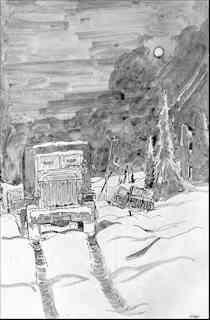
The 304th was in combat. As the troops deployed over chewed-up, icy roads into a dozen tiny Belgian villages--now ghost towns--they had their first glimpse of the 1945-style village fighting which was to become so characteristic of their own battle experience. Snowdrifts, covering fields and roads, mercifully veiled much of the debris of battle, but they could not hide the gaunt ruins of towns shattered by artillery fire and bombs, nor the wreckage of vehicles, tanks and equipment of the enemy.
All the "dry-runs" were now things of the past. The rehearsals were over. The curtain was going up. This--here in little
Beausaint in Belgium--on January 22nd, 1945 was the true
beginning in action for the regiment, the real Achtung!
Just a little distance from here, a matter of only a few kilometers, was the one-time vacation resort of
Laroche. It was a still angrily smoldering heap of rubble and ruins. The valley in which it lay was quiet, ominously so. And across the river and across the valley lay the enemy--in retreat truly enough, but nonetheless determined to inflict whatever mortal blows he could.
Few realized how close this enemy was even when the order came down to set up observation posts and patrols or when a house-to-house search was made for enemy personnel. Flares were reported at night and the flashing of some lights which might or might not have been signals; there were even the sounds of some small arms fire not far from the Regimental CP. But, for most of the men, this was passed off as the work of some too eager, too trigger-happy GIs. The realization of war was not yet complete.
Regimental Headquarters established itself in the manor house in
Beausaint. Billets of one sort or another were found in scattered sections throughout the village for all the allied units which now began their routine of traveling with the Command Post. Here for the first time, the 778th AAA set up its protective ring around the headquarters group. Here, the Security Platoon, drawn bodily from L Company, (and already having been formed back at
Youville l'Abbaye, France) came into active being under the wing of T/Sgt. Jock Labelle.
Snow lay heavy in the fields and formed a slippery, treacherous surface for traffic and made narrow roads into still narrower lanes. The metal chains on vehicles provided a lonesome symphony swelling and then fading in the night. The regimental I & R platoon set up here the first of its long sequence of observation posts, this one overlooking Laroche and the far slopes of the valley. A Belgian boy, Odon by name, who was the younger son of the house where the platoon was billeted, had gone with them during the daylight reconnaissance and helped them pick the sites. He knew this country as the palm of his hand--and well he might. He had been, at sixteen, one of the small army of Belgian Maquisards who had so long tormented the Germans with their hit-and-run guerrilla tactics. Had he been a little older he too, like his brother, would have been one of that hardy troop, the Belgian regiment known as the
Chasseurs des Ardennes. Had he been a little older yet he might also have had his other wish and gone along as a volunteer with the 304th Combat Team. Regretfully, because of this and other reasons, he had to be refused.
Beausaint also was the scene of the first roving, motorized patrols with their hourly reports: "Negative." 'Lights observed at 514--963 about 2100. Flashing on and off, ten second intervals." . . . "B-26 forced down; five flyers now in battalion aid station." . . . "Small arms fire, scattered, intermittent, reported approximately 1000 yards from 2nd battalion CP." Journals began to be kept, entries to be made; cross-checking between conflicting reports; and reports in turn to Division; and an endless mass of details, all appearing at first blush to be the piling of red-tape on red tape. Then, gradually, the system began to assume the semblance of a highly thorough and efficient mechanism, with all of the minutiae, all the details as important as the smallest cogs in a precision
machine.
|